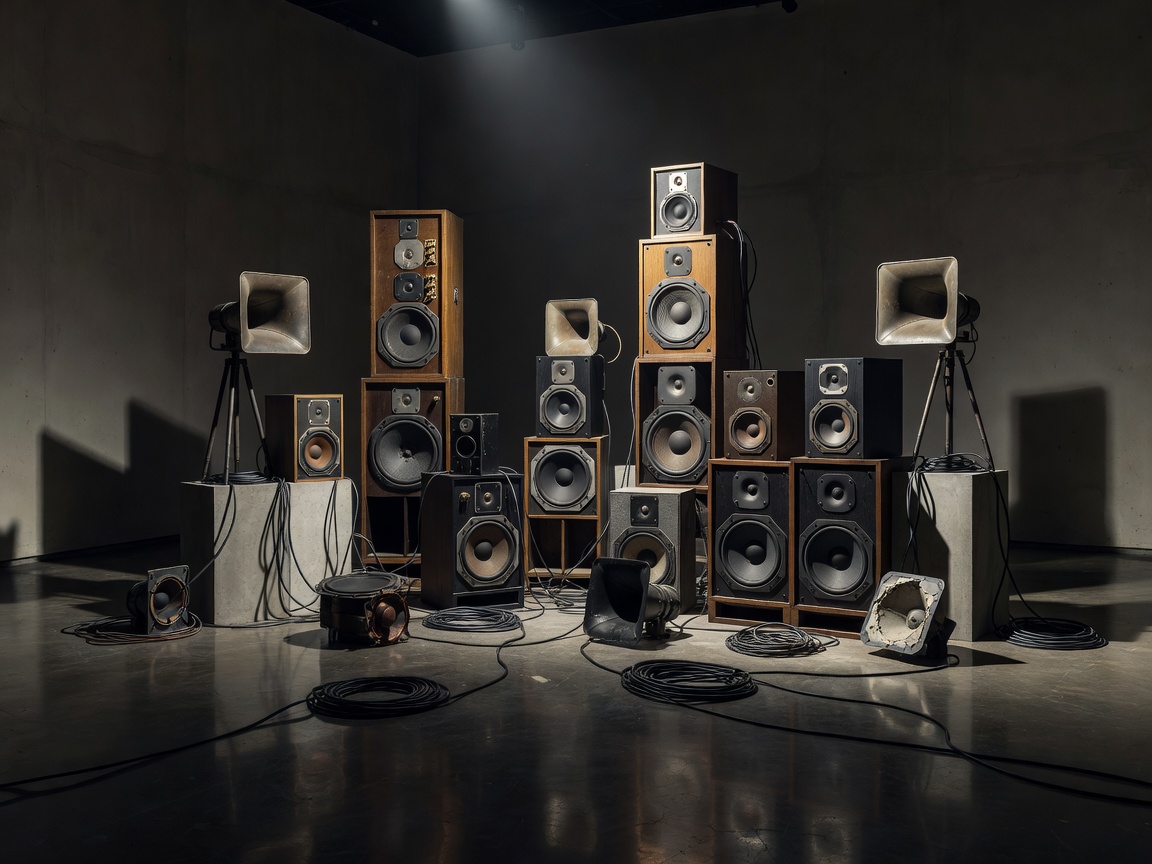
A sound installation arranges a listening situation rather than simply delivering a performance from a stage. It may use loudspeakers, resonant objects, architecture, environmental recordings or barely audible vibrations. The work might unfold continuously, respond to a visitor or change with conditions that nobody fully controls.
Unlike a conventional concert, an installation often leaves the audience to choose when to arrive, where to stand and how long to stay. Those freedoms are part of its form. Two visitors can encounter the same work differently without either having missed the single correct version. Attention becomes a kind of navigation.
Alvin Lucier: let the room speak
Alvin Lucier’s I Am Sitting in a Room begins with a spoken text that is recorded, played into a room and recorded again through successive generations. The room’s resonances increasingly shape the result, gradually transforming the intelligibility and texture of the voice. The process makes an acoustic environment audible through repetition.
The piece is not merely a demonstration that rooms have resonances. Its text, pacing and transformation turn a physical process into an artistic experience. Different rooms and realizations produce different results. That variability is central: the space is not a neutral container for a fixed recording but an active participant in what emerges.
Max Neuhaus: an encounter in public
Max Neuhaus’s Times Square places a sustained sound environment beneath a pedestrian area in New York. It resists many expectations associated with public sculpture: there is no monumental object to identify from a distance, and everyday urban sound remains part of the encounter. A passer-by may notice it before knowing that it is art.
This changes the role of a label. Information can help a visitor understand the work, but recognition is not necessarily its first event. The piece asks what attentive listening can discover inside a familiar place. If planning a visit, consult current information from the responsible organization, since maintenance, access and surrounding conditions can change.
Janet Cardiff: a choir separated and reunited
Janet Cardiff’s The Forty Part Motet presents separately recorded voices from Thomas Tallis’s Spem in alium through forty loudspeakers. Visitors can move near an individual voice or step back to hear a larger ensemble. The arrangement makes proximity a compositional tool, allowing personal routes through a shared musical structure.
Its emotional force does not require a constantly changing visual spectacle. The speakers are visible, but movement and listening do much of the work. A recording heard through ordinary headphones can introduce the music; it cannot fully reproduce the spatial choices of walking among the installation’s distributed sources.
Other ways to make a place audible
Maryanne Amacher investigated sound, architecture and perception through works that could create striking listening effects. Christina Kubisch’s Electrical Walks use specially equipped headphones to reveal electromagnetic activity through sound. Zimoun’s installations often organize many simple mechanical units into complex acoustic and visual fields. Each practice offers a different account of what an environment contains.
These examples should not be reduced to a checklist of equipment. A headphone walk organizes movement and discovery differently from a resonant chamber or an array of mechanical objects. Ask what the work makes available to attention, and how its technical choices support that invitation.
How to spend time with an installation
Begin by reading any safety and access information. Then, if the setting permits, listen before reading the full interpretation. Notice where sound seems to originate, whether it changes with position, and how the existing environment participates. Move slowly enough to hear transitions rather than only comparing endpoints.
Stay through more than one apparent cycle when possible. What first seems repetitive may contain small differences; what seems random may reveal a larger pattern. Equally, there is no requirement to endure discomfort. Leave, pause or ask staff about quieter access if the experience becomes overwhelming.
Documentation is a translation
A photograph can show an arrangement but not its changing acoustic relationships. A stereo video may capture some sound while flattening spatial distribution. Documentation is valuable, yet it should explain its limits. When comparing works online, avoid assuming that recording quality, playback volume or your own loudspeakers faithfully reproduce the original experience.
Sound art rewards a patient kind of curiosity. You do not need to identify every technology or recognize every reference. Start with what changes when you listen differently. The most important material may not be a spectacular sound at all, but a renewed awareness of the place you are already in.